

5 Things You Probably Didn’t Know About Dyscalculia
Dyscalculia is a frequently misunderstood learning disorder that impacts people far more than just “being bad at math.” Read about 5 key, often overlooked facts about this condition:
Dyscalculia is a frequently misunderstood learning disorder that impacts people far more than just “being bad at math.”
Here are 5 key, often overlooked facts about this condition:
It affects daily life beyond the classroom.
It causes issues with spatial awareness and time management, including difficulty reading analog clocks, estimating travel time, understanding directions (left versus right), or recalling schedules.
Even though it is much less known and talked about, it is about as common as dyslexia.
Dyscalculia affects about 5% to 10% of the population, which is about the same as the prevalence of dyslexia.
It is a neurological issue, not a motivation issue.
People with dyscalculia are not lazy or unmotivated. In fact, some of our students with dyscalculia are among the most motivated we have! It is a learning disorder, a neurodevelopmental disorder of biological origin, that makes it difficult to process numerical information. Students with dyscalculia often try harder than their peers, but are less successful in math and related topics. However, they can be much more successful with good instruction and practice, both of which we provide. Also, find resources for practicing math here.
It is not just “math anxiety.”
People with dyscalculia often have math anxiety due to frustrating experiences, but the two are not the same. Dyscalculia is a learning disability in the area of math, whereas anxiety is an emotional response, but one can exacerbate the other.
Signs can appear as early as preschool.
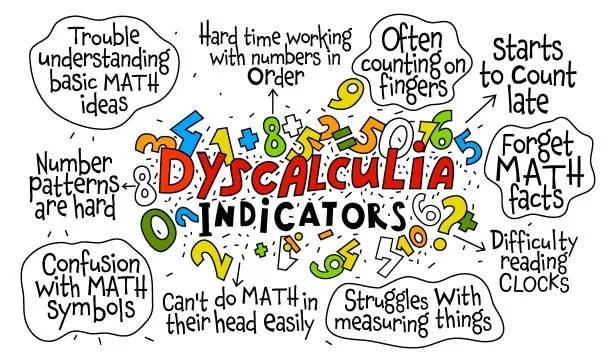
Signs of dyscalculia can show up in young children before they start formal math education. Early indicators include difficulty learning to count, struggling to recognize patterns (for example, largest to smallest), and difficulty connecting a number to a physical quantity of objects. However, the signs can look different in different children.
How Can You Help Your Child with Dyscalculia?
Use concrete manipulatives like Lego bricks, playing cards, dice, dominoes, cereal, grapes, or other objects to represent math problems physically.
Make math as applicable to your child’s real world as possible - are they interested in cooking? Have them measure ingredients, talk about doubling a recipe and then make that doubled recipe, work on telling time, and practice counting money.
Use visual aids such as graph paper to align columns of numbers, colour-code math operations, and use number lines.
Talk about the math involved in what interests them - are they into video games? Learn about their favourite game and talk to them about the math involved in it. Board games? Lots of math in many of those!
Break their assignments up into smaller, manageable chunks to help them tackle them.
Have your child use their strengths - maybe they struggle with math, but they are good at writing, so have them write about math vocabulary, math in their life, write a story that includes math, etc. Maybe they are creative, have them invent a board game that involves math and teach it to others.
How Can We Help Your Child with Dyscalculia?
We have a lot of experience teaching students who have dyscalculia and can get them caught up by one grade level in around 20 hours! Learn more about how we can help by reading our other article about dyscalculia.